
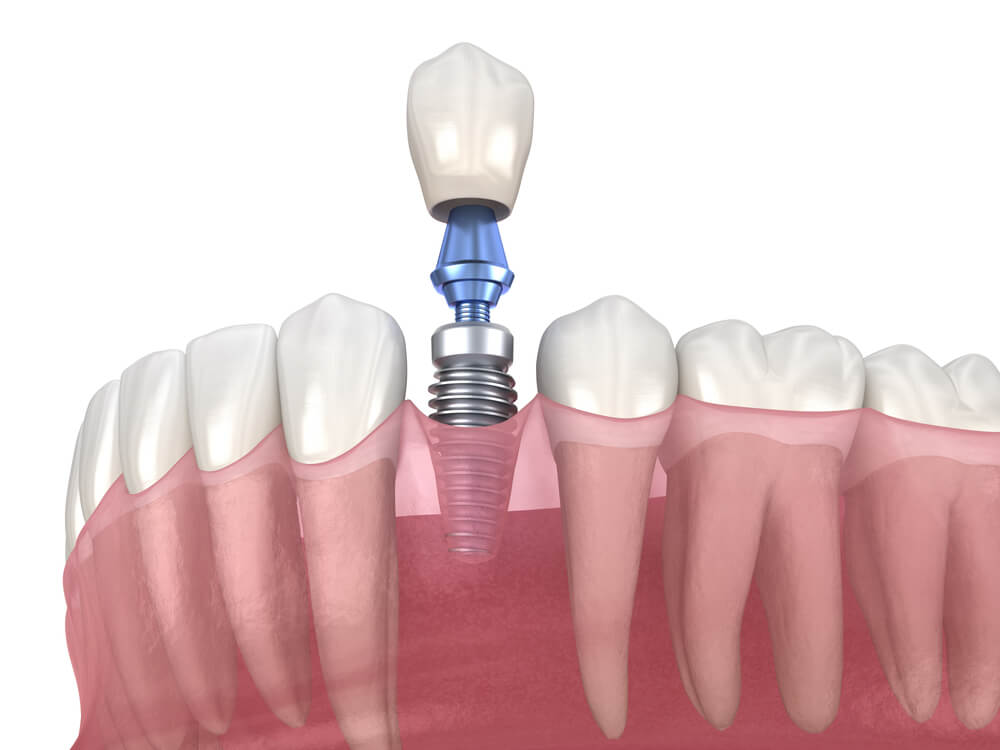
Dental implantation is an artificial replacement of the tooth root. The dental implant is made of titanium, which does not irritate the surrounding tissues and is fully compatible with the bone tissue of the jaw. After the process of osseointegration, that is, implantation into the bone, a denture is installed on the implant, whether it is a crown, a fixed bridge, or a removable prosthesis stabilized by implants.
This is a long-lasting and widely used solution that allows you to eliminate missing teeth in the most natural way or replace a removed tooth.
The implant can be installed by any person with a fully formed jaw, regardless of age, if the patient has enough bone tissue. If this condition is not enough, a bone grafting procedure can be performed in our clinic.
If the removable prosthesis slides and you can't comfortably consume your favorite foods, an implant-stabilized prosthesis may be the perfect solution! There are many options for such a prosthesis, and our specialist will be able to determine the best solution for you after personal consultation and evaluation of CT scan results.
It is also recommended to install a dental implant if only one tooth needs to be replaced, as this avoids turning adjacent teeth and replacing the tooth without damaging them.
Here are some reasons why you should consider replacing missing teeth with implants as soon as possible.:
Adjacent teeth may move towards the missing tooth, which may make chewing more difficult in the future.
If a missing tooth does not recover for a long time and the bone is not stressed, the bone tissue of the jaw may thin out.
During a meal, leftovers can enter the space formed by the missing tooth, which negatively affects neighboring teeth.
Depending on the location of the missing tooth, this can affect diction and speech, and tooth restoration has a positive effect on confidence and self-esteem.
Do you want to take care of your teeth?
Since the goal is to create a tooth or dentition that looks and functions naturally, it is first necessary to plan the location of the implants to be installed.
1) The first step: Consultation and planning
During a personal consultation, you will get to know your doctor, who will make an individual and accurate treatment plan for you. Based on the X-ray, oral examination and your needs, the doctor will develop a detailed individual treatment plan. For careful implantation planning, a 3D CBCT (Cone Beam CT) examination is required, which allows you to obtain a three-dimensional image.
The treatment plan includes the stages of prosthetics and detailed costs, recovery time intervals between necessary procedures, as well as recommendations for choosing the type of implant and its installation.
2) Second step: Installation of the implant(s)
The insertion of the implant(s) into the jawbone is painless; it is performed under local anesthesia or, optionally, under anesthesia. After surgery, the patient follows the relevant recommendations and instructions, waiting for the end of the recovery period, which is necessary for osseointegration (implantation into bone) and restoration of bone tissue.
If the volume of bone tissue is insufficient for dental implantation, a bone grafting procedure is used to replenish the missing bone tissue. This can be performed simultaneously with implantation, but if a significant amount of bone tissue needs to be restored, then a separate surgical operation is required before implantation.
3) The third step: Making the final tooth or dentition
Within 3-6 months after implantation, the implant fuses with the bone tissue of the jaw. During this period, it is extremely important to maintain excellent oral hygiene according to the recommendations.
After the end of the recovery period, a final crown, bridge, or denture is placed on the implants. There are various types of prostheses, ranging from removable dentures stabilized by implants, to full bridges fixed on 8 implants, and prostheses installed using the All-on-4 or All-on-6 technique.
The optimal solution for you will be offered in the treatment plan, drawn up on a personal consultation. If possible, the specialist will offer several options depending on personal preferences and requirements.
Do you still have any questions? Contact us
When installing a dental implant, regular dental checkups are even more important than with other dental procedures!
The big risk of neglecting regular checkups is that any gum infections, periosteum, or bone loss around the implant may go unnoticed.
Therefore, we strongly recommend visiting a dentist at least once a year for a routine checkup.